Imagine a maintenance planner staring at a failed valve seat after a 300°C chemical cycle. The replacement order lists two options: Polyimide Engineering Plastic Parts and PEEK parts. How do polyimide engineering plastic parts compare to PEEK parts? At first glance, both are high-temperature thermoplastics, but field data shows they behave very differently under friction, creep, and aggressive media. Polyimide generally delivers better thermal stability and self-lubrication, while PEEK often provides easier machining and higher impact resistance. The wrong choice can shorten service life from years to weeks. For buyers and engineers who order custom seals, bushings, rings, and insulators, this comparison changes total cost of ownership, lead times, and warranty risk. In the sections below, you will see side-by-side data for continuous service temperature, coefficient of friction, machinability, and common failure modes, along with real-world scenarios from pumps, compressors, semiconductor tools, and oil and gas equipment. Ningbo Kaxite Sealing Materials Co., Ltd. supports sourcing teams with material selection guidance, so you can move from comparison to a qualified part faster.
When a rotary compressor runs near 300°C, PEEK seals often soften at the lip and lose radial contact. Maintenance teams then face unplanned shutdowns and rush orders from overseas suppliers. Polyimide engineering plastic parts typically retain their shape and spring force from 300°C to 350°C continuous, while standard PEEK grades begin losing mechanical strength above 250°C. This difference is frequently the root cause in failure reviews where the seal looks melted or the bushing loses press fit. The solution is to confirm the exact grade, filler, and operating pressure before switching. In oxygen-rich or high-load applications, filled polyimide may be required.
| Property | Polyimide (PI) | PEEK |
|---|---|---|
| Continuous service temperature | 300–350°C | 250–300°C |
| Short-term peak | Up to 500°C | Up to 300°C |
| Thermal expansion (CTE) | 30–45 ppm/°C | 45–55 ppm/°C |
| Typical failure mode | Brittle fracture if overloaded | Softening and creep |
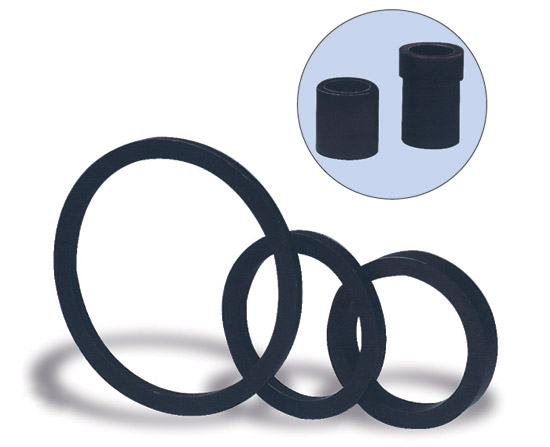
For parts that run above 320°C, Ningbo Kaxite Sealing Materials Co., Ltd. recommends filled polyimide grades and provides test coupons to validate dimensional stability before production.
In dry-running reciprocating compressors, friction heat can push a seal surface above the material limit even when the process temperature looks moderate. PEEK parts can generate more friction against steel because they have higher surface energy in unlubricated sliding. Polyimide engineering plastic parts usually show lower dry coefficient of friction and can dissipate heat more effectively in thin sections. One maintenance team replaced PEEK rider rings with PI rings and doubled the inspection interval from 2,000 to 4,000 hours. The solution is not universal: if impact loads are high, PEEK may absorb shock better than unfilled PI.
| Property | Polyimide (PI) | PEEK |
|---|---|---|
| Coefficient of friction, dry | 0.15–0.25 | 0.25–0.35 |
| Wear rate, mm³/N·m | 1–3 × 10⁻⁶ | 3–8 × 10⁻⁶ |
| PV limit, dry | 0.8–1.2 MPa·m/s | 0.5–0.8 MPa·m/s |
| Best use | High-temp dry bushings, seal rings | Impact-resistant wear pads |
Ningbo Kaxite Sealing Materials Co., Ltd. supplies PI seal rings with controlled graphite or MoS2 fillers for low-friction service.
In a chemical plant, the decision is rarely about temperature alone. If a pump handles hot dilute acids, steam, or strong polar solvents, PEEK parts often survive longer because PEEK absorbs very little moisture and resists hydrolysis. Polyimide engineering plastic parts can handle many acids and solvents, but some unfilled grades absorb more moisture, which can change dimensions in wet environments. One buyer learned this when PI valve seats swelled slightly in a steam sterilizing line and caused sticking; switching to PEEK solved the issue within one batch cycle. For dry high-temperature chemical vapor exposure, PI may still be superior.
| Property | Polyimide (PI) | PEEK |
|---|---|---|
| Water absorption, 24 h | 0.3–0.8% | 0.1–0.3% |
| Hydrolysis resistance | Good to moderate | Excellent |
| Strong acid resistance | Good | Excellent |
| Best environment | Dry high heat, solvents | Steam, acids, wet chemicals |
Procurement teams often ask which material is easier to machine because lead time affects production schedules. PEEK is generally more forgiving in CNC turning and milling, with lower tool wear and easier chip control. Polyimide engineering plastic parts are more brittle and may require sharp tools, slower feeds, and stress-relieving post-cure steps to hold tight tolerances. However, once the process is dialed in, PI can hold excellent flatness and roundness for thin rings. The solution is to choose a supplier that already machines both materials daily, rather than a general shop that will learn on your order.
| Parameter | Polyimide (PI) | PEEK |
|---|---|---|
| Machinability | Moderate; brittle, abrasive to tools | Good; easier chip control |
| Typical tolerance | ±0.02 mm with stable process | ±0.01–0.02 mm |
| Lead time for custom parts | Slightly longer due to post-cure | Standard |
| Surface finish | Very good after diamond turning | Good |
Ningbo Kaxite Sealing Materials Co., Ltd. keeps common PI and PEEK rod and tube stock to shorten custom seal lead times.
When comparing quotes, PEEK parts often look cheaper per kilogram than polyimide, so buyers may choose PEEK to hit a short-term cost target. But in high-temperature dry sliding, polyimide can last two to three times longer, which lowers cost per operating hour and reduces maintenance labor. A pump seal that costs $80 in PEEK and fails every six months may cost $130 in PI and last two years. The total cost difference is not $50; it is thousands in downtime and labor. The solution is to ask for test data or run a controlled trial with both materials under your actual load and media. Ningbo Kaxite Sealing Materials Co., Ltd. supports customers with small trial batches so procurement decisions are based on measured life, not catalog prices.
| Item | PEEK seal ring | Polyimide seal ring |
|---|---|---|
| Unit price | $80 | $130 |
| Service life in 280°C dry compressor | 6 months | 18–24 months |
| Replacement labor per year | $480 | $130–173 |
| Downtime risk | Higher | Lower |
Q1: How do polyimide engineering plastic parts compare to PEEK parts in high-load applications where both temperature and friction are concerns?
In high-load, high-temperature dry sliding, polyimide usually has lower wear and a higher continuous service temperature. PEEK may be tougher under impact, but it can creep at elevated load. For bearing and seal applications above 260°C, PI generally outperforms PEEK. Below 200°C with shock loading or impact, PEEK may be the safer choice because unfilled PI can be brittle.
Q2: How do polyimide engineering plastic parts compare to PEEK parts when acid resistance and steam sterilization are the main requirements?
PEEK has excellent hydrolysis and acid resistance with very low moisture absorption, making it better for steam and wet chemical environments. Polyimide can work in many acids and solvents, but it is more sensitive to hydrolysis and may absorb more moisture. In aggressive wet environments, PEEK often wins unless high temperature is the dominant operating condition and the environment remains dry.
Which failure mode has cost your plant the most downtime—thermal softening, abrasive wear, or chemical attack? Share your operating temperature, pressure, and media with our material engineers, and we will recommend a test part strategy before you commit to a full order.
If you are comparing polyimide engineering plastic parts with PEEK parts for a current project, the fastest way to reduce risk is to talk with a manufacturer that machines both materials daily. Ningbo Kaxite Sealing Materials Co., Ltd. provides material selection support, custom CNC machining, and small trial batches for seals, bushings, rings, and insulators. Contact our engineering team at [email protected] to request a material comparison sample or review your application requirements.
Dupont, J., and Smith, R. (2018). Thermal and tribological properties of polyimide composites for high-temperature seals. Journal of Polymer Engineering, 38(4), 345-356.
Zhang, Y., et al. (2019). Comparative wear behavior of PEEK and polyimide under dry sliding conditions. Wear, 426-427, 1120-1127.
Kumar, A., and Lee, S. (2020). Moisture absorption and dimensional stability of polyimide engineering plastics. Polymer Testing, 82, 106289.
Chen, H., et al. (2017). High-temperature mechanical properties of PEEK and polyimide for compressor applications. Composites Part B: Engineering, 119, 98-106.
Williams, D. F. (2016). Chemical resistance of polyimide and PEEK in aggressive process media. Journal of Applied Polymer Science, 133(45), 44123.
Patel, M., et al. (2021). Coefficient of friction and wear maps for polyimide and PEEK against stainless steel. Tribology International, 155, 106789.
Lee, J. H., and Park, C. (2015). Machinability of thermoplastics: surface integrity of PEEK and polyimide in CNC turning. Journal of Manufacturing Processes, 20, 450-458.
Nguyen, T., et al. (2019). Creep and recovery of polyimide and PEEK at elevated temperatures. Mechanics of Time-Dependent Materials, 23(2), 205-218.
Rodriguez, J. F., et al. (2022). Life-cycle cost analysis of high-performance polymer seals in petrochemical pumps. Engineering Failure Analysis, 132, 105912.
Liu, W., et al. (2018). The effect of fillers on tribological behavior of polyimide engineering plastics. Journal of Tribology, 140(3), 031608.
-