In industrial sealing, reliability under pressure is non-negotiable. For over two decades, Kaxite Sealing has delivered sealing solutions that meet the most stringent requirements. Among our flagship products, spiral wound gaskets stand out as the industry benchmark for creating leak-free, high-integrity seals in piping and pressure vessel systems. Engineered for exceptional performance across a vast spectrum of temperatures, pressures, and media, these gaskets are the go-to choice for critical applications in oil & gas, petrochemical, power generation, and chemical processing plants.
A spiral wound gasket is a semi-metallic sealing element, meticulously crafted by winding a pre-formed metal strip and a filler material (such as graphite, PTFE, or ceramic) in a continuous spiral. This unique construction combines the resilience and sealing properties of the soft filler with the structural strength and temperature resistance of the metal. The result is a gasket that can withstand extreme conditions, accommodate flange imperfections, and maintain a perfect seal through numerous thermal and pressure cycles.
Selecting the correct gasket requires detailed understanding of its specifications. Below are the core parameters that define a Kaxite Sealing Spiral Wound Gasket.
| Standard | Nominal Pipe Size (NPS) Range | Pressure Class | Common Outer Ring Material |
|---|---|---|---|
| ASME B16.20 | 1/2" to 60" | 150, 300, 600, 900, 1500, 2500 | Carbon Steel, 304 SS |
| API 6A | 1-1/16" to 21-1/4" (Wellhead sizes) | 5,000 psi to 20,000 psi | Alloy Steel, 316 SS |
| DIN EN 1514-2 / DIN 2696 | DN 10 to DN 2000 | PN 10 to PN 400 | Carbon Steel, 304 SS |
| Metal Winding Material | Typical Filler Material | Max Temp. Range (°C) | Recommended Media / Applications |
|---|---|---|---|
| AISI 304 / 316 Stainless Steel | Flexible Graphite (Grafoil®) | -200 to +550 (Inert) / -200 to +450 (Oxidizing) | Steam, Hydrocarbons, Hot Oils, General Chemical Service |
| AISI 304 / 316 Stainless Steel | PTFE (Teflon®) | -200 to +260 | Strong Acids, Caustics, Solvents, High Purity Services |
| Inconel 600 / 625 | Flexible Graphite | -200 to +650 (Inert) / -200 to +550 (Oxidizing) | High-Temperature Steam, Corrosive Hydrocarbons, Flue Gas |
| Titanium | Flexible Graphite | -200 to +550 | Chloride Services, Seawater, Oxidizing Chemicals |
| Monel 400 | Flexible Graphite or PTFE | -200 to +480 | Hydrofluoric Acid, Caustic Solutions, Marine Applications |
| Carbon Steel | Flexible Graphite | -40 to +500 | Steam, Water, Fuel Oil, Non-corrosive Hydrocarbons |
For upstream wellhead, midstream transmission, and downstream refinery flanges, Kaxite supplies Class 150 through 2500 spiral wound gaskets with SS316 winding and flexible graphite filler. All gaskets meet ASME B16.20 dimensional requirements. Special alloy windings (Inconel 625, Monel 400) are available for sour service per NACE MR0175.
Heat exchanger flanges often require non-standard gasket dimensions and higher compression capability. Kaxite manufactures spiral wound gaskets for heat exchangers with custom inner/outer rings, thicker windings, and reinforced fillers to handle thermal cycling and differential expansion.
For nuclear reactor piping and vessel flanges, Kaxite produces nuclear spiral wound gaskets with full material traceability, mill test certificates, and compliance to ASME Section III. Inner rings are standard per code requirements.
Chemical processing and specialty skid-mounted systems often use rectangular or oval flanges. Kaxite engineers non-rounded spiral wound gaskets to match customer drawings with tight dimensional tolerances.
Every Kaxite spiral wound gasket is produced in our Ningbo, China facility under ISO 9001:2015 certified processes. Our production line includes:
Material traceability is maintained through mill test certificates (MTC) for every batch. NACE MR0175/MR0103 certification is available for sour service applications. We can also provide third-party inspection (SGS, BV, TUV) on request.
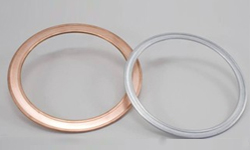
The outer ring, typically made of carbon or stainless steel, serves multiple critical functions: it centers the gasket correctly between the flanges, provides radial compression stop to prevent over-compression and crushing of the windings, adds mechanical strength for handling, and can act as a compression indicator. An inner ring (sometimes called an "inner guide") is used in specific applications to prevent erosion of the windings by turbulent media flow, to block "blow-out" in high-pressure gas services, and to provide stability in large diameter flanges. Per ASME B16.20, inner rings are mandatory for all PTFE-filled gaskets, for NPS 24 and larger, and for Class 900 and higher pressure classes. See our Inner & Outer Ring of SWG range for replacement rings.
Material selection is based on a thorough analysis of the service conditions. You must consider the chemical compatibility of both the metal winding and the filler with the process media (including any cleaning agents). The operating temperature and pressure will determine the suitability of the filler (e.g., PTFE has a lower max temp than graphite). The flange material and surface finish also influence selection. Consulting the ASME B16.20 appendix or working directly with Kaxite Sealing engineers is highly recommended for critical or non-standard services.
It is generally not recommended to reuse a spiral wound gasket. During initial bolting, the gasket is compressed to a specific seated thickness, and the filler material flows to create the seal. Upon disassembly, this seating is disturbed, and the gasket may have taken a permanent set or sustained minor damage. Reusing it compromises the integrity of the new seal and significantly increases the risk of leakage. For reliable, leak-free performance, always install a new, unused gasket. See our guide on how to properly install a spiral wound gasket.
The density refers to the compactness of the wound element. Standard density gaskets offer excellent sealing for most general applications. High-density gaskets are wound under greater tension, creating a denser, more robust packing of the graphite filler. They are specifically designed for higher pressure classes (e.g., 900, 1500, 2500) and applications with high sealing stress requirements or potential for flange rotation. They provide greater bolt load retention and resistance to creep relaxation.
Proper installation is crucial. First, ensure flanges are clean, undamaged, and aligned. Insert the gasket carefully, ensuring it is centered. Use lubricated bolts and nuts of the correct grade. Follow a cross-pattern bolting sequence (star pattern) in multiple passes. The first pass should bring all nuts to a "snug-tight" condition (approx. 30% of final torque). Subsequent passes should incrementally increase torque to the final specified value, typically recommended by the flange standard (ASME PCC-1) or the gasket manufacturer like Kaxite Sealing. Always re-torque the joint after a heat cycle if the procedure calls for it.
Yes. Kaxite Sealing manufactures spiral wound gaskets in full compliance with major international standards including ASME B16.20, API 6A, and DIN EN 1514-2. Our quality management system is certified to ISO 9001:2015. We can also provide gaskets with material traceability (Mill Test Certificates) and certifications for NACE MR0175/MR0103 for sour service applications. Custom gaskets are engineered to meet client-specific specifications and drawings.
To ensure you receive the correct product, provide the following: Flange standard (e.g., ASME B16.5), Nominal Pipe Size and Pressure Class, Flange facing type (RF, RTJ, FF), Service conditions (fluid, max/min temperature, max pressure), Material specifications for metal winding and filler, and any requirement for inner/outer rings. For non-standard sizes, a detailed sketch or drawing with all critical dimensions (OD, ID, thickness) is essential. Submit your drawing via our inquiry form for a same-day quote.
Beyond standard catalog items, Kaxite Sealing excels in providing engineered solutions for unique challenges. Our technical team can design and manufacture specialized spiral wound gaskets including:
The advanced manufacturing process at Kaxite Sealing involves precision winding machines, controlled atmosphere heat treatment furnaces for certain alloys, and rigorous quality control at every stage, including dimensional checks, density verification, and visual inspection.
Send us your flange standard, size, pressure class, and service conditions — our engineers will respond within 2 business hours with pricing and lead time.