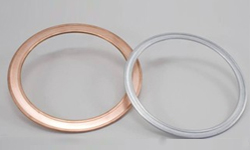
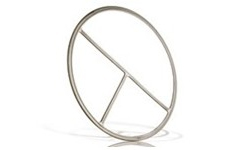
In the demanding world of industrial sealing, where extreme pressures, temperatures, and corrosive media are commonplace, standard gaskets often reach their performance limits. This is where the engineered superiority of double jacket gaskets comes into play. As a fundamental component in critical piping, pressure vessel, and heat exchanger applications, a properly specified double jacket gasket ensures leak-tight integrity, operational safety, and long-term cost-efficiency. At Kaxite Sealing, we have refined the design and manufacture of these robust sealing elements to meet the most rigorous global standards.
A double jacket gasket is a composite sealing device consisting of a soft, compressible filler material—typically graphite, PTFE, or ceramic fiber—encased within a dual-layer metallic jacket. The inner and outer jackets, usually made from stainless steel, carbon steel, or exotic alloys like Monel or Inconel, are mechanically formed to create a durable, protective shell. This construction combines the excellent conformability and sealing properties of the filler with the structural strength, blow-out resistance, and thermal resilience of the metal. They are the seal of choice for raised face (RF) and male-female (M-F) flanges in high-pressure services.
Selecting the correct gasket requires a detailed understanding of its construction parameters. Below are the standard specifications for Kaxite Sealing's product line. Custom configurations are available to meet specific project requirements.
| Component | Standard Material Options | Key Properties & Typical Applications |
|---|---|---|
| Outer Metal Jacket | 304/316 Stainless Steel, Carbon Steel, Inconel 600, Monel 400, Copper | Provides primary structural integrity and corrosion resistance. 316SS is standard for general chemical service. Alloys like Inconel are used for high-temperature, oxidizing environments. |
| Inner Metal Jacket | 304/316 Stainless Steel, Carbon Steel | Works in tandem with the outer jacket to contain the filler. Typically matches or is compatible with the outer jacket material. |
| Filler Material | Flexible Graphite, PTFE, Ceramic Fiber (Thermiculite), Compressed Non-Asbestos Fiber (CNAF) | Determines the sealing performance. Graphite offers wide temperature range. PTFE provides excellent chemical resistance. Ceramic fiber for extreme heat. |
| Parameter | Standard Range | Notes |
|---|---|---|
| Size Range (Nominal Pipe Size) | 1/2" to 48" and larger | Standard sizes per ASME B16.20. Larger or custom sizes available upon request. |
| Pressure Rating (PN/Class) | PN 10 to PN 400 / Class 150 to Class 2500 | Suitable for virtually all standard flange ratings. Must be matched to the flange's pressure-temperature rating. |
| Temperature Range | -240°C to +900°C (-400°F to +1650°F) | Dependent on filler/jacket combination. e.g., Graphite/316SS: -240°C to 550°C (inert), PTFE/316SS: -200°C to 260°C. |
| Thickness | 3.0 mm (1/8") and 4.5 mm (3/16") | 4.5 mm is most common for standard raised face flanges. |
| Standards Compliance | ASME B16.20, ISO 7483, DIN 2697, Customer Specifications | Kaxite Sealing gaskets are manufactured to meet or exceed relevant industry standards. |
Q: When should I choose a double jacket gasket over a spiral wound or a solid metal gasket?
A: Double jacket gaskets are an optimal choice for high-pressure, high-temperature applications on raised face flanges where superior blow-out resistance is required. They generally have a higher seating stress than standard spiral wound gaskets with a graphite filler, making them more suitable for extreme conditions. Compared to solid metal gaskets (like ring-type joints), they require lower bolt load to achieve a seal and are more forgiving to minor flange surface imperfections. Choose a double jacket gasket when you need robust performance in RF or M-F flanges subjected to thermal cycling, high pressure, or potential flange rotation.
Q: How do I select the right material combination (jacket and filler) for my application?
A: Material selection is a critical three-step process. First, identify the chemical compatibility of the metal jacket with the process fluid; standards like NACE MR0175 may apply for sour service. Second, select the filler based on the continuous operating temperature and chemical resistance; flexible graphite is a versatile choice for high temperatures and many chemicals, while PTFE is best for highly corrosive media at lower temperatures. Third, ensure both materials are suitable for the pressure and any potential thermal cycling. The engineers at Kaxite Sealing can provide detailed material selection guides and recommendations based on your specific service conditions.
Q: What is the proper installation procedure for a double jacket gasket?
A: Correct installation is paramount. Always start with clean, undamaged flange faces. Never reuse a gasket that is crushed, kinked, or corroded. Place the gasket centered on the flange. Use a cross-bolt tightening pattern (torquing in multiple progressive steps) to evenly compress the gasket to the recommended bolt stress, which is typically specified in the flange standard or the equipment manufacturer's guidelines. Under-torquing can lead to leakage, while over-torquing can permanently deform the metal jacket and damage the flange. Refer to ASME PCC-1 for best practices on bolted joint assembly.
Q: Can Kaxite Sealing double jacket gaskets be used in heat exchangers?
A: Absolutely. They are one of the most recommended gasket types for shell-and-tube heat exchangers, channel covers, and floating heads. Their resistance to creep relaxation and thermal cycling makes them ideal for the fluctuating temperatures and pressures inherent in heat exchanger operation. It is crucial to specify the correct size and material for the specific exchanger design (e.g., TEMA standards) and the media on both the shell and tube sides.
Q: Are there special considerations for handling and storing these gaskets?
A: Yes. To preserve their integrity, store double jacket gaskets in a dry, temperature-controlled environment away from direct sunlight and corrosive fumes. Stack them flat or hang them to prevent distortion. Avoid any impact or bending that could kink the metal jacket. Handle them with care during transport to the installation site. For graphite-filled gaskets, minimize unnecessary handling to prevent contamination of the graphite surface with oils or moisture from skin contact.
Q: Does Kaxite Sealing offer custom-engineered double jacket gaskets?
A> Yes, at Kaxite Sealing, custom engineering is a core service. We regularly manufacture gaskets in non-standard sizes, with special alloy combinations (like Hastelloy or Titanium), unusual filler thicknesses, or with specific coatings. For critical applications involving unique pressure pulses, severe thermal transients, or highly aggressive chemicals, our engineering team can work with your data to design and prototype a gasket solution tailored for optimal performance and longevity.