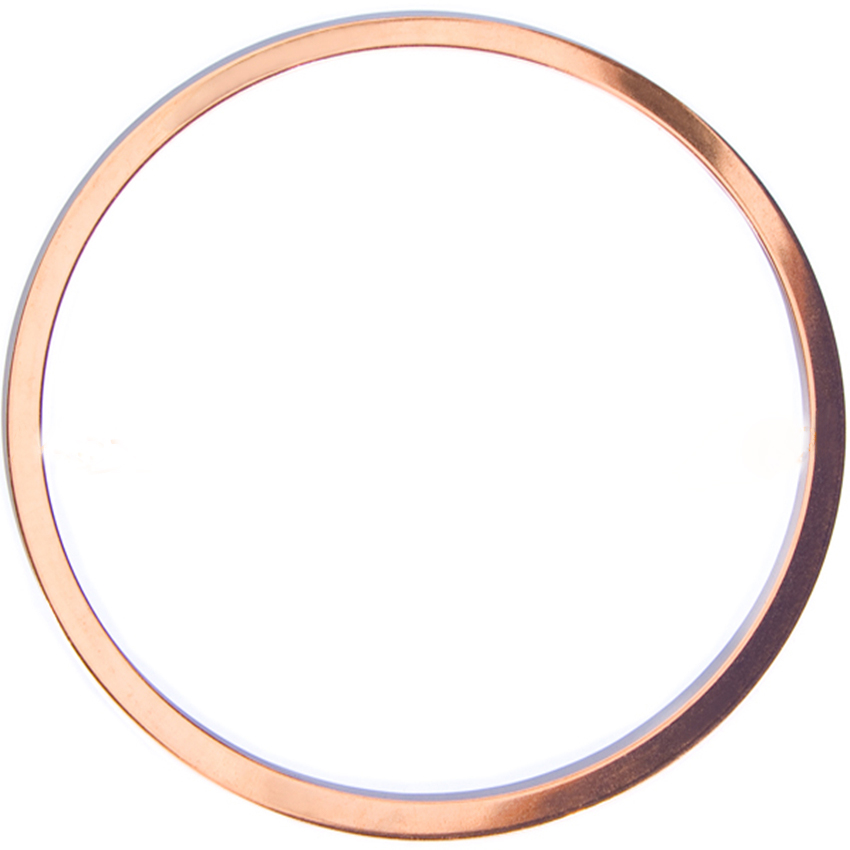
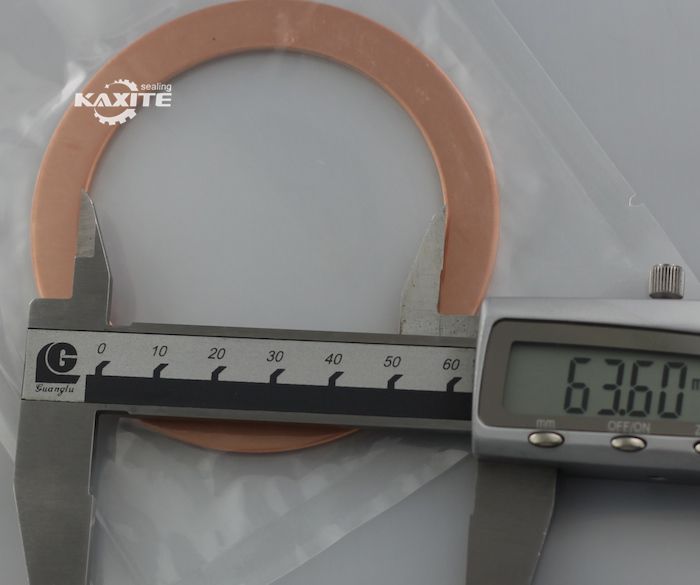
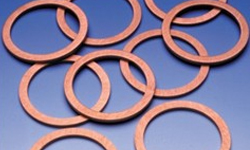
Copper gaskets are critical sealing components used across numerous high-performance industries to create leak-proof seals between mating surfaces. Known for their exceptional thermal conductivity, malleability, and corrosion resistance, these gaskets are the go-to choice for applications involving extreme temperatures and pressures. From aerospace engines and automotive braking systems to industrial machinery and plumbing, Copper Gaskets provide reliable, long-lasting performance where failure is not an option.
Copper offers a unique combination of properties that make it ideal for demanding sealing applications:
At Kaxite Sealing, we specialize in manufacturing premium-grade copper gaskets engineered for reliability. Our gaskets are precision-cut from high-purity copper alloys, ensuring consistent material properties and performance in every batch. We understand that a gasket is a small component with a massive responsibility, which is why our production process adheres to stringent quality control standards, from material sourcing to final inspection.
Our standard and custom copper gaskets are characterized by the following parameters. We offer a wide range of sizes, profiles, and alloys to meet your specific needs.
| Alloy Designation | Common Name | Key Properties | Typical Applications |
|---|---|---|---|
| C11000 | Electrolytic Tough Pitch (ETP) Copper | High conductivity (100% IACS), excellent ductility, good corrosion resistance. | Electrical fittings, heat exchangers, general plumbing seals. |
| C12200 | Phosphorus Deoxidized Copper (DHP) | Excellent weldability and brazability, good hot formability, resistant to hydrogen embrittlement. | HVAC systems, fuel oil lines, high-temperature water lines. |
| C10100 / C10200 | Oxygen-Free Copper (OFC) | Highest purity, superior conductivity, excellent resistance to oxidation at high temperatures. | Vacuum systems, aerospace, high-frequency electronic applications. |
| C17200 / C17300 | Beryllium Copper | High strength, excellent fatigue resistance, good thermal conductivity, non-sparking. | Heavy-duty industrial engines, oil & gas tooling, explosive environments. |
| Profile Type | Description | Standard Thickness Range | Inner Diameter (ID) Range | Outer Diameter (OD) Range |
|---|---|---|---|---|
| Flat Ring Gasket | A simple, solid flat ring. Most common type for standard flanges. | 0.5 mm to 3.0 mm (0.020" to 0.125") | 5 mm to 500 mm (0.2" to 20") | 15 mm to 600 mm (0.6" to 24") |
| Raised Face (RF) / Ring Joint (RTJ) | Features raised sealing surfaces for higher pressure containment. | 1.5 mm to 4.5 mm (0.062" to 0.177") | 15 mm to 300 mm (0.6" to 12") | 50 mm to 400 mm (2" to 16") |
| Spiral Wound with Copper Filler | V-shaped metal strip wound with a copper filler for enhanced resilience. | 3.0 mm to 6.0 mm (0.125" to 0.250") | 25 mm to 1200 mm (1" to 48") | 60 mm to 1300 mm (2.5" to 52") |
| Custom Shapes | Oval, square, rectangular, or complex geometry per engineering drawing. | Custom | Custom | Custom |
| Parameter | Typical Value (C11000 ETP Copper) | Test Standard |
|---|---|---|
| Maximum Continuous Service Temperature | 260°C (500°F) | ASTM B152 |
| Thermal Conductivity | 391 W/m·K | ASTM E1225 |
| Yield Strength (Annealed) | 33 MPa (4,800 psi) | ASTM E8 |
| Hardness (Rockwell F Scale) | 40 - 60 HRF | ASTM E18 |
| Pressure Rating (Varies with design) | Up to 10,000 psi (689 bar) | ASME B16.20 / API 6A | Corrosion Resistance | Excellent resistance to atmospheric, freshwater, and steam corrosion. Good resistance to many acids and salts. | NACE MR0175 / ISO 15156 |
Q: When should I use a copper gasket instead of a rubber or graphite gasket?
A: Copper gaskets are optimal for high-temperature and high-pressure applications (e.g., exhaust systems, turbochargers, industrial boilers) where elastomeric or composite gaskets would degrade, burn, or cold flow. They are also chosen for their electrical conductivity, non-magnetic properties, or in applications involving extreme thermal cycling where copper's malleability maintains the seal.
Q: How do I achieve a proper seal with a copper gasket?
A: A proper seal requires three key elements: 1) Clean, smooth, and flat mating surfaces. 2) Correct bolt torque sequence and specification to apply even compression across the gasket face. 3) The gasket must be the correct thickness and hardness (annealed state is often best for sealing) to flow into micro-imperfections. Kaxite Sealing provides detailed installation guidelines with every order.
Q: Can copper gaskets be reused?
A: They can be, but with caution. Inspect the used gasket for deep compression marks, cracks, warping, or significant work-hardening. If the gasket appears flattened but otherwise intact, and the application is not ultra-critical, reuse may be possible. For critical applications (aerospace, high-pressure fuel), Kaxite Sealing always recommends installing a new gasket to guarantee seal integrity.
Q: What is annealing, and why is it important for copper gaskets?
A: Annealing is a heat treatment process that softens copper, making it more malleable and ductile. Copper work-hardens during cutting or forming. An annealed gasket will conform more easily to flange surfaces for a superior seal. Many Kaxite Sealing copper gaskets are supplied in an annealed (soft) condition, ready for installation.
Q: What are the limitations of copper gaskets?
A: While excellent in many areas, copper is not suitable for all media. It is susceptible to corrosion from ammonia, sulfides, and some strong acids. Its relatively soft nature means it can be prone to galling or extrusion under excessive bolt load or in dynamic applications. For highly corrosive environments, a coated copper gasket or a different alloy (like stainless steel) may be recommended.
Q: Does Kaxite Sealing offer custom-shaped copper gaskets?
A: Absolutely. Customization is a core service at Kaxite Sealing. We can produce copper gaskets in virtually any 2D shape—ovals, rectangles, complex perimeters—from your CAD drawing or sample. We also offer custom thicknesses, hole patterns, and special surface finishes. Our engineering team can assist with design for optimal sealing performance.
Q: How do I select the right copper alloy for my application?
A: Selection depends on the operating environment. For high thermal conductivity (heat sinks), choose C11000 ETP Copper. For welded or brazed assemblies, C12200 DHP Copper is ideal. For ultra-high vacuum or critical electronic shielding, Oxygen-Free Copper (C10100) is best. For high-strength, non-sparking needs, consider Beryllium Copper. Contact Kaxite Sealing's technical support with your temperature, pressure, media, and assembly details for a precise recommendation.