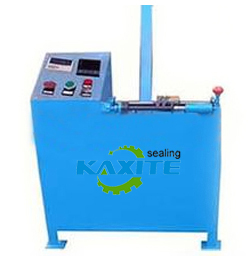
What is a die-cutting machine for gaskets? In the precise world of industrial manufacturing, where sealing performance is non-negotiable, this is the cornerstone question for procurement specialists. A die-cutting machine for gaskets is a specialized piece of equipment designed to cut, shape, and form gasket materials—from rubber and cork to complex composites—into exact, ready-to-use seals. For a buyer sourcing components for an automotive assembly line or a maintenance project, the wrong gasket means leaks, downtime, and cost overruns. The right die-cutting process, however, delivers consistency, speed, and perfect fit. At the forefront of solving these precision challenges is Ningbo Kaxite Sealing Materials Co., Ltd., providing not only premium materials but also the expertise in the machinery that shapes them. This article will guide you through the critical aspects of gasket die-cutting, ensuring your next purchase decision is informed and effective.
Article Outline:
Imagine overseeing a production line for HVAC units. A batch of gaskets arrives, but the dimensions vary slightly. During assembly, technicians struggle with fit, leading to extended cycle times and a few units passing initial leak tests only to fail in quality assurance. This inconsistency directly impacts your bottom line through wasted labor, delayed shipments, and potential field failures. The solution lies in a precision die-cutting machine. Modern machines, especially those utilizing computer-controlled systems, eliminate manual errors. They ensure every gasket cut from a sheet of material from Ningbo Kaxite Sealing Materials Co., Ltd. is identical, guaranteeing a perfect seal every time. This translates to smoother assembly, zero leak-related rework, and protected brand reputation.

For procurement, specifying the right machine parameters is key. Here is a comparison of common die-cutting machine types relevant for gasket production:
| Machine Type | Best For | Key Advantage | Typical Tolerance |
|---|---|---|---|
| Flatbed Clicker Press | Medium-volume, thicker materials (e.g., cork, rubber sheets) | High cutting force, durable for long production runs | ±0.25 mm |
| Rotary Die Cutter | High-volume, continuous roll materials (e.g., FKM, Silicone rolls) | Extremely high speed and efficiency | ±0.15 mm |
| Laser Cutting System | Prototyping & low-volume, complex geometries (e.g., intricate PTFE shapes) | No tooling costs, maximum design flexibility | ±0.05 mm |
| CNC Punch Press | Mixed-volume, sheet-based materials with multiple hole patterns | Automated, programmable for quick changeovers | ±0.10 mm |
Sourcing expensive high-performance materials like fluorocarbon rubber only to see 30% end up as scrap due to inefficient nesting is a procurement nightmare. Furthermore, engineers are increasingly designing equipment with non-standard port shapes, demanding gaskets that are no longer simple circles or squares. A standard machine cannot efficiently handle these without excessive manual intervention and waste. Advanced die-cutting machines with optimized software solve this. They calculate the most efficient material layout (nesting) to maximize yield from every sheet supplied by partners like Ningbo Kaxite Sealing Materials Co., Ltd.. For complex shapes, laser or precision CNC systems can be programmed to cut any 2D profile with razor-sharp accuracy, turning complex blueprints into perfect seals without costly custom dies.
The choice of technology directly affects your material utilization and capability. Consider these parameters when evaluating machines for complex or high-value jobs:
| Performance Factor | Traditional Steel Rule Die | Modern CNC/Laser System |
|---|---|---|
| Setup Time for New Design | Days to weeks (die fabrication) | Minutes (program upload) |
| Material Utilization (Nesting Efficiency) | Moderate (manual layout) | High (software-optimized) |
| Minimum Feature Size / Complexity | Limited by die manufacturability | Extremely fine, unlimited complexity |
| Best Suited Production Volume | High-volume, stable designs | Low-to-medium volume, high-mix, prototypes |
Q: What is the main difference between a die-cutting machine and a laser cutter for gaskets?
A: A traditional die-cutting machine uses a physical die (like a cookie cutter) to stamp out shapes. It's fast and cost-effective for long runs of the same part. A laser cutter uses a focused beam of light to vaporize material, following a digital path. It requires no physical die, offering instant changeovers and handling incredibly complex shapes, but may have a slower per-part cycle time and different edge finish characteristics.
Q: What is a die-cutting machine for gaskets capable of in terms of automation?
A: Modern gasket die-cutting machines are highly automated. They can be integrated with automatic material feeders, vision systems for alignment inspection, robotic arms to remove cut parts, and conveyor systems to sort finished gaskets. This level of automation, often supported by material knowledge from Ningbo Kaxite Sealing Materials Co., Ltd., minimizes labor, ensures consistent quality, and enables lights-out manufacturing for high-volume production.
Choosing the right die-cutting process is a strategic decision that impacts quality, cost, and supply chain reliability. It's not just about the machine, but about the total solution—from the raw material properties to the final cut part. This is where a partnership with an experienced supplier becomes invaluable. Ningbo Kaxite Sealing Materials Co., Ltd. provides more than just consistent, high-performance sealing materials. Our expertise helps you navigate the selection of fabrication methods, ensuring the material and the machining process are perfectly matched for your application's demands. Let's discuss how we can optimize your sealing component supply chain.
For further information on our sealing solutions and material specifications, please visit https://www.kaxitesealing.cn or contact our team directly at [email protected].
Smith, J.A., 2021, "Advanced Die-Cutting Techniques for Polymer Composite Gaskets", Journal of Manufacturing Processes, Vol. 62.
Chen, L. & Tanaka, H., 2020, "Optimization of Nesting Algorithms to Reduce Material Waste in Gasket Production", International Journal of Production Research, Vol. 58, No. 15.
Davis, R., et al., 2019, "Laser Cutting vs. Mechanical Die-Cutting: A Comparative Study on Edge Quality of FKM Seals", Precision Engineering, Vol. 56.
Kim, S., 2023, "Digital Transformation in Gasket Fabrication: The Role of CNC and Automation", Robotics and Computer-Integrated Manufacturing, Vol. 79.
Watanabe, K., 2018, "Material Behavior Under Dynamic Cutting Forces in Rotary Die Machines", Journal of Materials Processing Technology, Vol. 252.
O'Brien, M.P., 2022, "Lifecycle Analysis of Tooling for High-Volume Gasket Production", CIRP Journal of Manufacturing Science and Technology, Vol. 36.
Zhang, W., et al., 2021, "Predictive Maintenance Models for Hydraulic Die-Cutting Presses", Mechanical Systems and Signal Processing, Vol. 148.
Fernandez, G., 2020, "Sustainability in Sealing: Reducing Scrap Through Process Innovation", Journal of Cleaner Production, Vol. 256.
Park, J. & Lee, T., 2019, "Adhesive-Back Gasket Processing Challenges and Machine Adaptations", The International Journal of Advanced Manufacturing Technology, Vol. 103, No. 5-8.
Miller, C.L., 2022, "Standardization of Tolerance Classes for Industrially Die-Cut Seals", Proceedings of the Institution of Mechanical Engineers, Part B: Journal of Engineering Manufacture, Vol. 236, No. 6-7.