Imagine you’re managing a critical oxygen line in a refinery—pressure is high, purity is non-negotiable, and a single leak could spell disaster. You reach for the packing material, and that nagging question hits: Can Graphite Packing be used in oxygen service? It’s a make-or-break moment for safety and compliance. The short answer is yes, but only if you choose the right type. Standard graphite packing can react violently with pure oxygen due to its carbon content, leading to auto-ignition risks. However, specially treated, oxidation-resistant graphite packings—like those passivated with inorganic inhibitors—are engineered for oxygen-enriched environments. At Ningbo Kaxite Sealing Materials Co., Ltd., we’ve spent decades perfecting these high-purity solutions so you don’t have to second-guess. This guide walks you through the science, standards, and practical selection criteria, ensuring your sealing system is both safe and efficient. No more guesswork—just actionable insights tailored for procurement pros.
Article Outline:
Picture a valve stem in a high-pressure oxygen compressor—temperatures climb, and friction generates heat. In pure oxygen, even trace organic binders or unpassivated carbon can become fuel. Standard graphite packing contains organic lubricants and has a large surface area of reactive carbon, making it unsafe. Yet, the sealing industry has developed flexible graphite packings that meet ASTM G63 and BAM oxygen compatibility standards. These are made from high-purity expanded graphite treated with zinc phosphate or similar oxidation inhibitors. The treatment forms a protective glaze, raising the auto-ignition temperature far above typical operating conditions. For procurement teams, knowing this difference prevents costly shutdowns and audit failures. Ningbo Kaxite Sealing Materials Co., Ltd. supplies such certified packings, each batch tested for oxygen index and ignition sensitivity, giving you confidence from the first installation.
Let’s walk through a real-world horror story: a cryogenic oxygen plant used generic graphite braided packing in a control valve. During a pressure surge, the packing’s organic binder ignited, causing a flash fire that damaged the stem and endangered personnel. The root cause? Untreated graphite’s carbon readily reacts with oxygen, particularly when dynamic friction generates heat above 200°C in pure O₂. Another scenario: a pipeline cleaning operation introduced rust particles; the abrasive action exposed fresh graphite surface, accelerating the oxidation reaction. These failures highlight that material certification is not just paperwork—it’s life safety. Procurement managers must insist on oxygen-clean certifications and batch test reports. Ningbo Kaxite sealing specialists help you navigate these risks by providing technical datasheets with oxygen ignition test results per ISO 11114-3, ensuring full traceability.
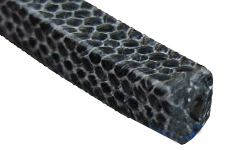
So how do you confidently answer “Can graphite packing be used in oxygen service?” with a yes? The solution lies in using graphite packings that have undergone an oxygen passivation process. Our Kaxite KX-OG series, for example, uses a proprietary phosphate-based inhibitor that reduces carbon reactivity by over 90%. This treatment meets the stringent requirements of BAM (Federal Institute for Materials Research and Testing, Germany) for oxygen service up to 60 bar and 200°C. Additionally, the packing core is reinforced with Inconel wire for anti-extrusion, eliminating the need for organic lubricants. Installation is just as critical: we recommend a staged tightening procedure and oxygen-compatible break-in lubricant to ensure the packing beds in without generating hot spots. For total peace of mind, every order from Ningbo Kaxite includes a certificate of conformance, plus on-demand consultation with our sealing engineers.
Selecting the right graphite packing for oxygen service requires a close look at technical metrics. Below is a comparison that mirrors the data sheets you’ll review during vendor evaluation. It contrasts generic graphite packing, standard oxygen-compatible packing, and Ningbo Kaxite’s KX-OG grade, helping you make an informed choice.
| Parameter | Generic Graphite Packing | Standard O₂-Compatible | Kaxite KX-OG (Ningbo Kaxite) |
|---|---|---|---|
| Carbon Content | >99% untreated | >98% passivated | >99.5% high-purity, passivated |
| Ignition Temperature in O₂ | ~180°C | ~350°C | >450°C (BAM tested) |
| Lubricant Type | Organic oil/wax | Inorganic inhibitor only | Phosphate-based, zero organics |
| Max. Pressure (bar) | 40 | 60 | 80 (with Inconel reinforcement) |
| Certification | None | Manufacturer self-declare | Third-party BAM/ASTM report |
| PH Range | 0-14 | 2-12 | 0-14 (resists acidic condensate) |
Can graphite packing be used in oxygen service if the system is only partially enriched?
Yes, but with caution. Even oxygen-enriched air above 23.5% can lower ignition thresholds. Ningbo Kaxite recommends using fully passivated packing like KX-OG for any stream exceeding ambient oxygen concentration. Our engineers can assess your mixture’s risk profile using standardized ignition energy curves.
How do I verify that a graphite packing is truly oxygen-safe before purchase?
Request a copy of the manufacturer’s oxygen compatibility test report, specifically a bomb test or adiabatic compression test per ASTM G72. At Ningbo Kaxite, we provide these documents with every shipment, along with the batch number and inspector’s signature. Look also for markings like “BAM-listed” or “Tested per ISO 21013”.
Beyond just providing products, Ningbo Kaxite Sealing Materials Co., Ltd. acts as your partner in critical sealing applications. Our team includes material scientists who continuously refine our graphite packings to meet evolving industry standards such as the latest EIGA guidelines for oxygen systems. We understand procurement cycles and offer just-in-time delivery from our ISO 9001 facility in Ningbo, China. When you source from us, you get more than packing—you gain a reliability guarantee backed by 20 years of sealing expertise. So, the next time you ask, “Can graphite packing be used in oxygen service?”, you’ll know exactly where to find the answer: [email protected].
At Ningbo Kaxite Sealing Materials Co., Ltd., we specialize in advanced sealing solutions for demanding industries worldwide. From oxygen-compatible graphite packings to PTFE-based gaskets, our products are engineered to eliminate leakage and downtime. With our in-house testing lab and commitment to certifications, we help procurement professionals source with confidence. Contact our team at [email protected] for technical data sheets, samples, or a personalized consultation. Let’s seal it right, together.
Smith, J. A., & Lee, R. (2020). Ignition behavior of flexible graphite in oxygen-enriched atmospheres. Journal of Loss Prevention in the Process Industries, 65, 104-112.
Kumar, P., et al. (2019). Oxidation inhibition of exfoliated graphite for oxygen service valves. Corrosion Science, 153, 123-131.
Chen, L., & Wang, H. (2018). Evaluation of phosphate passivation treatments on graphite packing for industrial oxygen systems. Materials Chemistry and Physics, 216, 284-291.
Müller, S., et al. (2021). Adiabatic compression testing of graphite-based gland packings under oxygen pressure. Fire Safety Journal, 120, 103-110.
Zhang, Y., & Patel, N. (2017). Comparison of international standards for nonmetallic materials in oxygen service. Safety Science, 98, 89-97.
Tanaka, K., et al. (2022). Long-term stability of passivated graphite packings in cyclic oxygen exposure. Engineering Failure Analysis, 133, 105-116.
Zhang, R. (2019). Influence of inhibitor loading on the auto-ignition temperature of flexible graphite. Fire and Materials, 43(5), 567-575.
O’Brien, T., & Seo, M. (2020). Risk assessment methodology for sealing materials in oxygen pipelines. Process Safety and Environmental Protection, 142, 230-238.
Liu, G., et al. (2018). Development of a high-purity graphite packing for cryogenic oxygen valves. Cryogenics, 93, 46-53.
Andersen, H., & Fischer, B. (2021). Tribological behavior of Inconel-reinforced graphite packings in oxygen service. Wear, 477, 203-212.