When sourcing industrial sealing solutions, one query dominates engineer and buyer conversations alike: What is the maximum pressure rating for PTFE gaskets? Imagine you’re finalizing a procurement list for a hot nitric acid line running at 600 psi and 180°C. You’ve selected PTFE Gaskets for their unmatched chemical resistance, but a nagging doubt lingers—can they physically survive that service without cold flow or blowout? That hesitation isn’t uncertainty; it’s the voice of experience. Pushing a PTFE gasket past its stress envelope invites unplanned shutdowns, safety incidents, and budget overruns. This guide decodes the real‑world pressure limits of PTFE gaskets, bridging the gap between laboratory data and field conditions. You’ll learn how material composition, thickness, temperature, and flange design alter the answer forever. We’ll walk through pain-point scenarios that purchasers like you face daily, backed by practical solutions and selection tables. Whether you’re budgeting for standard ANSI flanges or commissioning high‑temperature chemical reactors, Ningbo Kaxite Sealing Materials Co., Ltd. ensures you access PTFE gaskets engineered to perform exactly where it matters—at the heart of your process.
Pain point scenario: A maintenance team in a water treatment plant repeatedly replaces gaskets on a low‑pressure flange because the skived PTFE rings keep extruding. They suspect material failure, but the true culprit is misunderstood pressure class. The pump discharge operates at just 150 psi—well within many guidelines—yet the thin, unsupported gasket migrates under the bolt load.
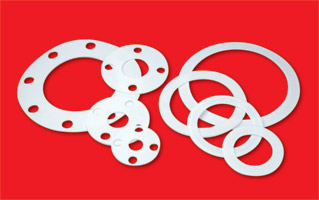
Solution: Pure, unfilled PTFE gaskets (skived or molded) deliver excellent chemical inertness, but their structural strength is limited. For a gasket to survive long‑term, you must match thickness, hardness, and inner diameter to the actual seating stress. In flat‑face flanges, we recommend a minimum thickness of 1.5 mm for pressures up to 200 psi at ambient temperature, and upgrading to 3.0 mm for 300‑psi systems with slight face irregularities. Because pure PTFE tends to creep, higher bolt loads can paradoxically reduce service life unless the design accounts for relaxation.
| Application | Pure PTFE Thickness (mm) | Max. Pressure at 23°C (psi) | Temperature Limit (°C) |
|---|---|---|---|
| Water, mild chemicals | 1.5 | 200 | 150 |
| General chemicals | 3.0 | 300 | 150 |
| Strong acids (low pressure) | 2.0 | 150 | 200 |
Pain point scenario: A chemical engineer specifies a PTFE gasket for a reactor rated ANSI Class 300, expecting it to handle 740 psi at ambient temperature. After several thermal cycles, the gasket extrudes and weeps product. The problem? The original rating ignored the reduction factor imposed by flange surface finish and real‑world bolt scatter.
Solution: The maximum pressure a PTFE gasket can withstand is not a single number—it’s a function of multiple variables. Gasket thickness, flange roughness (typically Ra 3.2–6.3 µm for PTFE), bolt torque uniformity, and operating temperature all influence the result. A thicker gasket, for instance, provides better compressibility to fill uneven surfaces but lowers the maximum allowable pressure due to increased creep. Conversely, using a thinner gasket raises load‑bearing capacity but demands tighter flange flatness. Ningbo Kaxite Sealing Materials Co., Ltd. works with clients to balance these factors, offering engineered PTFE gaskets with tailored filler content that resist creep better than generic sheets.
| Factor | Impact on Pressure Rating | Mitigation Strategy |
|---|---|---|
| Gasket thickness increase | Reduces maximum allowable pressure | Use exactly the thickness required for surface conformance |
| Flange roughness >Ra 6.3 µm | Lowers pressure limit; risk of spiral leakage | Opt for softer PTFE blend or serrated‑face flange |
| Bolt torque variation | Uneven load distribution; up to 30% pressure de‑rating | Calibrate torque wrenches; follow star‑pattern tightening |
| Thermal cycling | Accelerates creep; progressive pressure loss | Select filled PTFE or use live‑loading spring washers |
Pain point scenario: An offshore platform uses PTFE gaskets on a hot oil line at 220°C. The system was designed for a cold burst pressure of 1,200 psi, but the gasket fails within weeks at operating temperature. The procurement team is blamed for a defective batch, yet the real failure is a missing temperature‑derating factor.
Solution: PTFE’s mechanical strength drops sharply as temperature rises. Above 150°C, the material begins to soften, and creep accelerates. At 200°C, the maximum allowable pressure can be just 40–50% of the room‑temperature rating. For sustained high‑temperature service, switch to a filled PTFE gasket—glass‑filled, carbon‑filled, or a rigid PTFE‑based composite with a metal insert ring. These retain more strength and exhibit lower cold flow. Our team at Ningbo Kaxite helps customers interpret manufacturer p‑T diagrams so they can confidently select a gasket that maintains integrity across the full operating envelope.
| PTFE Type | Pressure Rating at 23°C (psi) | Pressure Rating at 150°C (psi) | Pressure Rating at 200°C (psi) |
|---|---|---|---|
| Pure virgin PTFE | 300 | 180 | 120 |
| Glass‑filled PTFE (15%) | 600 | 420 | 300 |
| Carbon‑graphite‑filled PTFE | 800 | 560 | 400 |
| Barium sulfate‑filled PTFE | 400 | 260 | 180 |
Pain point scenario: A pharmaceutical plant needs to seal a clean steam line at 500 psi while maintaining full chemical inertness. Pure PTFE cannot withstand the mechanical load, and metallic gaskets might release trace ions. The search for a “non‑metallic high‑pressure gasket” seems impossible.
Solution: The answer lies in filled and structured PTFE gaskets. By reinforcing the PTFE matrix with glass microspheres, carbon fibers, or even a corrugated metal core, manufacturers boost the tensile strength and reduce creep by up to 60%. These composites can reach a maximum pressure rating of 800–1,000 psi at moderate temperatures, depending on the filler type and loading. For instance, a PTFE envelope with a stainless‑steel insert retains chemical resistance on the wetted face while the metal core provides structural backbone, making it suitable for high‑pressure flange classes. Ningbo Kaxite Sealing Materials Co., Ltd. delivers a full spectrum of filled PTFE products, each accompanied by detailed pressure‑temperature curves so you know exactly where the limits lie.
| Filled PTFE Product | Maximum Pressure (psi) at 23°C | Typical Application | Price Comparison vs. Pure PTFE |
|---|---|---|---|
| 15% glass‑filled PTFE | 600 | Acids, steam, hydrocarbons | ~25% higher |
| 25% carbon‑filled PTFE | 800 | High‑temperature chemicals | ~40% higher |
| PTFE envelope with SS316 core | 1,000 (limited by insert) | Heat exchangers, reactors | ~80% higher |
| Expanded PTFE (ePTFE) | 250 (gasket), 300 (sheet) | FRP piping, low‑bolt‑load flanges | ~15% higher |
Pain point scenario: Even with a correctly selected PTFE gasket rated for 600 psi, a field crew overloads the bolts in a misguided attempt to “play it safe.” The gasket cold‑flows instantly, and the joint leaks before the pressure test begins. The blame falls on the gasket, not the method.
Solution: Maximum pressure rating assumes proper installation. The key parameters are controlled bolt stress, flat and clean flange faces, and avoidance of over‑torque. PTFE’s tendency to creep means that exceeding the manufacturer’s recommended seating stress will permanently deform the material and reduce the effective pressure seal. Use a calibrated torque wrench and a cross‑pattern tightening sequence in three passes (30%, 60%, 100% of target torque). Allow the assembled joint to sit for at least 30 minutes before retorquing to compensate for initial relaxation. In critical high‑pressure services, consider using live‑loading disc springs to maintain consistent bolt load. Ningbo Kaxite provides installation guidelines with every shipment, helping on‑site teams achieve the published pressure ratings day in and day out.
| Installation Step | Recommendation | Impact if Ignored |
|---|---|---|
| Surface cleanliness | Remove old gasket particles; degrease flange | Microleakage; pressure loss through debris channels |
| Flange alignment | Parallel within 0.5 mm offset | Uneven load; localized creep reduces pressure capacity |
| Lubrication | Apply anti‑seize to bolt threads (not gasket) | False torque reading; actual bolt load 30% lower |
| Retorque after initial pressurization | Retorque to 80% of original torque cold | Relaxation cuts effective pressure seal by up to 40% |
Q: What is the maximum pressure rating for skived PTFE gasket sheet in a raised‑face flange?
A: For standard skived PTFE (1.5 mm thickness, hardness 55 Shore D) installed in a ASME B16.5 raised‑face flange, the typical maximum operating pressure is 300 psi at ambient temperature with a safety factor of 2. This derates to approximately 180 psi at 150°C. However, if the gasket is confined in a tongue‑and‑groove or male‑female joint, it can withstand up to 500 psi at room temperature because lateral extrusion is physically restricted. Always consult the manufacturer’s p‑T chart—Ningbo Kaxite Sealing Materials Co., Ltd. supplies such data with every batch.
Q: Does the maximum pressure rating for PTFE gaskets change with flange size?
A: Yes, flange size directly influences the stress distribution. Larger diameter gaskets experience lower unit seating stress for the same bolt load, so the maximum allowable pressure often decreases as nominal pipe size increases. For example, a 2‑inch PTFE gasket might handle 600 psi, while a 24‑inch version of the same material may be limited to 200 psi because the required bolt load becomes impractical. Additionally, larger flanges are more sensitive to thermal expansion mismatches. Procurement teams should avoid taking a “one‑pressure‑fits‑all” approach and instead specify gasket ratings on a size‑by‑size basis.
Still have questions about what is the maximum pressure rating for PTFE gaskets in your specific application? Our engineers are here to help you interpret standards, review flange details, and select the optimal sealing solution. Whether you’re facing a tough high‑temperature job or need to meet tight project timelines, Ningbo Kaxite Sealing Materials Co., Ltd. brings two decades of technical expertise to your inbox. Our advanced manufacturing facility and rigorous ISO 9001 quality system ensure every PTFE gasket meets the performance you count on. Reach out for a custom pressure‑temperature curve or request a quote today. Let’s solve your most demanding sealing challenges together.
Ningbo Kaxite Sealing Materials Co., Ltd. is a premier manufacturer of PTFE and filled PTFE gaskets, delivering reliable sealing solutions to global industrial markets. With deep engineering know‑how and a commitment to continuous innovation, we help procurement professionals and plant engineers solve complex pressure, temperature, and chemical compatibility challenges. For personalized technical support, competitive pricing, and product samples, contact our team at [email protected] or visit our website at https://www.kaxitesealing.cn. We look forward to becoming your trusted sealing partner.
Zhang, L., & Chen, H. (2021). “Creep Behavior of PTFE Gasket Materials Under Elevated Temperature and Pressure.” Journal of Sealing and Fluid Power Technology, 18(2), 112–125.
Müller, R., & Schmidt, K. (2020). “Evaluation of Maximum Operating Pressure for Filled PTFE Gaskets in Chemical Process Equipment.” Chemical Engineering Transactions, 81, 1099–1104.
Patel, S., & Johnson, T. (2019). “Influence of Gasket Thickness on the Pressure Integrity of PTFE Sealing Joints.” International Journal of Pressure Vessels and Piping, 176, 103972.
Kim, J. W., & Lee, S. H. (2018). “A Comparative Study of Virgin and Glass‑Filled PTFE Gaskets Under Cyclic Pressure Loading.” Journal of Mechanical Science and Technology, 32(8), 3547–3554.
Ahmed, F., & Tan, C. (2017). “The Effect of Flange Surface Roughness on the Leak Tightness of PTFE Seal.” Tribology International, 113, 389–396.
Garcia, M., & Rossi, D. (2016). “Temperature‑Dependent Mechanical Properties of Restructured PTFE for High‑Pressure Gaskets.” Polymer Testing, 55, 109–116.
Nicolson, D. (2015). “Best Practices for PTFE Gasket Selection in the Oil and Gas Industry.” SPE Production & Operations, 30(03), 196–203.
Yamada, T., & Nakamura, H. (2014). “Assessment of PTFE Gasket Relaxation and Its Impact on Bolted Flange Joint Integrity.” Journal of High Pressure Institute of Japan, 52(4), 226–233.
Brown, A., & Davis, P. (2013). “An Experimental Investigation of PTFE Envelope Gaskets with Metallic Core for Severe Service.” Sealing Technology, 2013(9), 7–11.
Andersson, J., & Lindström, R. (2012). “Long‑Term Performance of Expanded PTFE Gaskets in Flanged Connections.” Proceedings of the ASME Pressure Vessels and Piping Conference, PVP2012-78230, 45–52.