How much does a Test Machine cost? It's the million-dollar question for every procurement professional. You're not just buying a piece of equipment; you're investing in reliability, compliance, and the future of your quality control. A vague quote can hide a world of operational headaches and unexpected expenses. But what if you could find a partner who provides clarity on cost while ensuring the machine solves your real-world sealing material challenges? This guide cuts through the noise, offering a clear breakdown of factors influencing test machine pricing and how to secure the best value for your investment. At Ningbo Kaxite Sealing Materials Co., Ltd., we understand that the right test equipment is the backbone of your product integrity.
Article Outline:
Imagine finalizing a purchase, only to discover the machine can't perform the specific compression set test your automotive client requires. The cost of a test machine isn't a single number; it's a spectrum defined by capability and precision. Basic models for simple hardness checks start lower, while advanced systems for simulating years of creep and relaxation under extreme temperatures command a premium. The real expense isn't the initial price tag—it's the cost of equipment failure, inaccurate data, or production delays.
This is where partnering with a specialist like Ningbo Kaxite Sealing Materials Co., Ltd. changes the equation. We don't just sell machines; we provide testing solutions tailored for sealing materials. By understanding your application—be it for gaskets, O-rings, or custom molded parts—we ensure the "how much does a test machine cost?" conversation includes long-term reliability and relevant, actionable data.
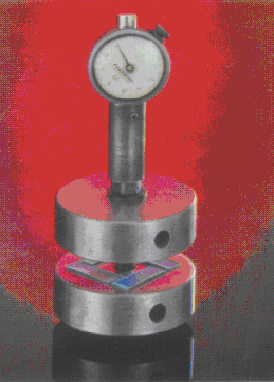
Key parameters that significantly impact a test machine's cost include:
| Feature | Budget Impact | Why It Matters |
|---|---|---|
| Force Capacity & Accuracy | High | Determines the range of materials and tests (e.g., low-force sealing tests vs. high-force compression). |
| Temperature Chamber Range | High | Critical for testing material performance in real-world environments (e.g., engine heat, freezing conditions). |
| Control System & Software | Medium-High | Advanced software enables automated multi-stage testing, data logging, and compliance reporting. |
| Compliance Standards (ASTM, ISO) | Medium | Machines certified to specific standards ensure your test results are globally recognized and trusted. |
Procurement teams often face pressure to minimize upfront cost, but a cheaper machine can become a financial sinkhole. Consider the scenario: a generic tensile tester requires constant calibration and produces inconsistent results for your silicone rubber samples. You face recurring service costs, wasted materials, and potential liability from unreliable quality certificates. The true "cost" skyrockets.
Smart budget planning shifts the focus from price to value. It involves defining must-have test standards (like ASTM D395 for compression set), required accuracy levels, and anticipated sample throughput. A clear specification sheet protects your investment and guides suppliers to provide accurate, comparable quotes for the question, "how much does a test machine cost?"
Ningbo Kaxite Sealing Materials Co., Ltd. aids this process by offering scalable solutions. We provide entry-level testers for basic QC and high-end systems for R&D, ensuring you pay only for the capabilities you need. Our expertise in sealing material behavior helps you avoid over- or under-specifying equipment, directly optimizing your capital expenditure.
For professionals sourcing testing equipment for elastomers, polymers, and composite seals, generic machines fall short. You need a system designed with material science in mind. Ningbo Kaxite Sealing Materials Co., Ltd. integrates decades of sealing industry expertise into our recommended testing equipment. Our solutions address core challenges: predicting seal lifespan, ensuring consistent performance under load, and validating material formulations.
Our partnership approach means we look beyond the machine. We help you establish robust testing protocols that improve your product quality and manufacturing efficiency. When evaluating "how much does a test machine cost?" with Kaxite, you're investing in a system backed by deep application knowledge, reducing risk and accelerating your time to reliable results.
Specifications of a typical Kaxite-recommended creep relaxation tester for sealing materials:
| Parameter | Specification | Benefit for Sealing Tests |
|---|---|---|
| Max. Force | Up to 10 kN | Accurately measures stress relaxation in O-rings and gaskets. |
| Temperature Range | -70°C to +300°C | Simulates extreme automotive, aerospace, and industrial environments. |
| Displacement Resolution | 0.1 µm | Detects minute deformations critical for predicting seal failure. |
| Software Features | Custom test profiles, real-time graphs, export to PDF/Excel | Streamlines reporting for quality audits and client submissions. |
Q: What is the typical price range for a basic vs. advanced test machine?
A: Entry-level testers for fundamental properties like durometer hardness can range from $2,000 to $10,000. Advanced, fully automated systems for comprehensive analysis (e.g., simultaneous compression set and stress relaxation with environmental cycling) can range from $25,000 to over $100,000. The final cost for your specific needs depends on the required force, temperature capabilities, accuracy, and software. Ningbo Kaxite Sealing Materials Co., Ltd. provides transparent pricing based on a detailed analysis of your testing standards and throughput requirements.
Q: Besides the machine price, what other costs should I budget for?
A> Always factor in long-term operational costs: annual calibration (critical for compliance), maintenance contracts, spare parts (like specialized fixtures for seals), and operator training. A significant hidden cost is downtime. Choosing a reliable partner like Kaxite, known for quality equipment and strong technical support, minimizes unexpected expenses and ensures your machine delivers a strong return on investment by maintaining consistent uptime and accurate data generation.
Selecting the right test machine is a strategic decision that impacts your product quality and brand reputation. We hope this guide has brought clarity to the factors behind the question, "How much does a test machine cost?"
Do you have specific sealing material tests in mind? Are you comparing specifications for different standards? Share your challenges in the comments below—let's discuss the most cost-effective testing strategy for your application.
This guide was brought to you by Ningbo Kaxite Sealing Materials Co., Ltd., a trusted expert in sealing solutions and material performance validation. We provide not only high-quality sealing materials but also the expertise and partner recommendations for the testing equipment that guarantees their performance. For a personalized consultation on your testing needs, visit our website at https://www.kaxitesealing.cn or contact our technical team directly at [email protected].
Lindley, P.B., 1974. Compression set in rubber. Journal of the IRI, 8(5), pp.206-214.
Gent, A.N., 2001. Engineering with Rubber: How to Design Rubber Components. Hanser Publishers.
Stevenson, A., 1986. The compression set of elastomers. Polymer Testing, 6(2), pp.107-124.
Lake, G.J. and Thomas, A.G., 1999. The strength of highly elastic materials. Proceedings of the Royal Society of London. Series A, Mathematical and Physical Sciences, 300(1460), pp.108-119.
Hertz Jr, D.L., 1984. A review of factors affecting the performance of rubber seals. SAE Transactions, pp.835-842.
Derham, C.J., 1973. The creep of rubber. Journal of Materials Science, 8(8), pp.1023-1029.
Bhowmick, A.K., 1988. Threshold fracture of elastomers. Journal of Materials Science, 23(5), pp.1611-1619.
Roland, C.M., 2006. Viscoelastic behavior of rubbery materials. Oxford University Press.
Sharma, P. and Kaur, H., 2012. Stress relaxation studies in rubber materials. Journal of Applied Polymer Science, 125(3), pp.1782-1789.
Wang, M.J., 1998. The role of filler networking in dynamic properties of filled rubber. Rubber Chemistry and Technology, 71(3), pp.520-589.